Google Gemini Agentic Video Understanding: What It Means for Video Editors
Google's agentic video understanding makes Gemini better at finding moments inside long videos. Learn what changed, where it fits in a professional workflow, and why searchable video libraries still matter.
Google's new agentic video understanding makes Gemini better at finding specific moments inside long videos, but it does not replace a searchable video library or a professional pre-editing workflow. Cutsio is built for the layer that comes next: finding, organizing, selecting, tightening, and handing off footage across an entire library before the final edit.
What is Google Gemini agentic video understanding?
Google Gemini agentic video understanding is a processing mode that lets Gemini decide which parts of a video to inspect instead of treating the entire file as a fixed stream of sampled frames. The model can navigate the timeline, retrieve transcripts, inspect frames, listen to audio, change frame rates, and stop when it has enough evidence to answer the question.
That is a meaningful improvement over static video processing. In a static workflow, the model commonly samples video at a fixed rate, such as one frame per second, and places those observations into context in one pass. That approach is predictable, but it can waste tokens on irrelevant sections and miss brief visual events between samples.
Agentic processing changes the model's role from passive observer to active investigator. It starts with a question, forms a plan for finding the answer, requests relevant evidence from the video, and can revisit a short section at higher temporal detail when the first pass is not enough.
Google has released the feature across Gemini 3.7 Flash, Gemini 3.6 Flash, and Gemini 3.5 Flash-Lite. It is available for uploaded videos and YouTube videos through the Gemini API, Google AI Studio, and the Gemini Enterprise Agent Platform.
What changed in Gemini's video analysis?
The central change is selective inspection: Gemini can choose what to watch, how closely to watch it, and whether visual frames, audio, or transcript evidence is most useful for the task.
Google describes four capabilities that become more practical with this approach:
| Capability | What it helps a model do | Video-team example |
| --- | --- | --- |
| Sub-second moment retrieval | Find brief state changes, actions, or cut boundaries | Locate the exact moment a presenter reveals a slide or a player makes contact with the ball |
| Long-form needle-in-a-haystack search | Search multi-hour recordings without loading every moment equally | Find every section of a conference recording that discusses a specific product decision |
| Anomaly detection | Revisit interesting windows at a higher frame rate | Inspect a suspected defect, dropped object, or unusual movement in inspection footage |
| Action and object counting | Track repeated actions or distinct objects over time | Count passes, product units, vehicles, or repetitions in a long recording |
These use cases share a common problem: the answer may depend on a small part of a long recording. A model that spends the same amount of attention on every second has to choose between high cost and low detail. A model that can search first and inspect second can spend more attention where the evidence is likely to be.
How much more efficient is agentic video processing?
Google reports up to 88% lower token consumption, up to 66% lower analysis cost, and up to 7% higher quality on its tested long-form video workloads. These are maximum benchmark results, not a guaranteed discount or accuracy increase for every file and prompt.
The gains should be strongest when a video is long and the question targets a specific moment. A 90-minute lecture with one relevant passage gives the system plenty of irrelevant material to skip. A short clip where every frame matters offers much less opportunity for selective retrieval.
| Metric | Google's reported maximum | How to interpret it |
| --- | ---: | --- |
| Token consumption | Up to 88% lower | Agentic mode can load only the evidence needed for a question, but usage varies with the model's navigation strategy and video complexity. |
| Analysis cost | Up to 66% lower | This is not a fixed price reduction on every API request. |
| Quality | Up to 7% higher | The result applies to tested long-form benchmarks, not every type of visual task. |
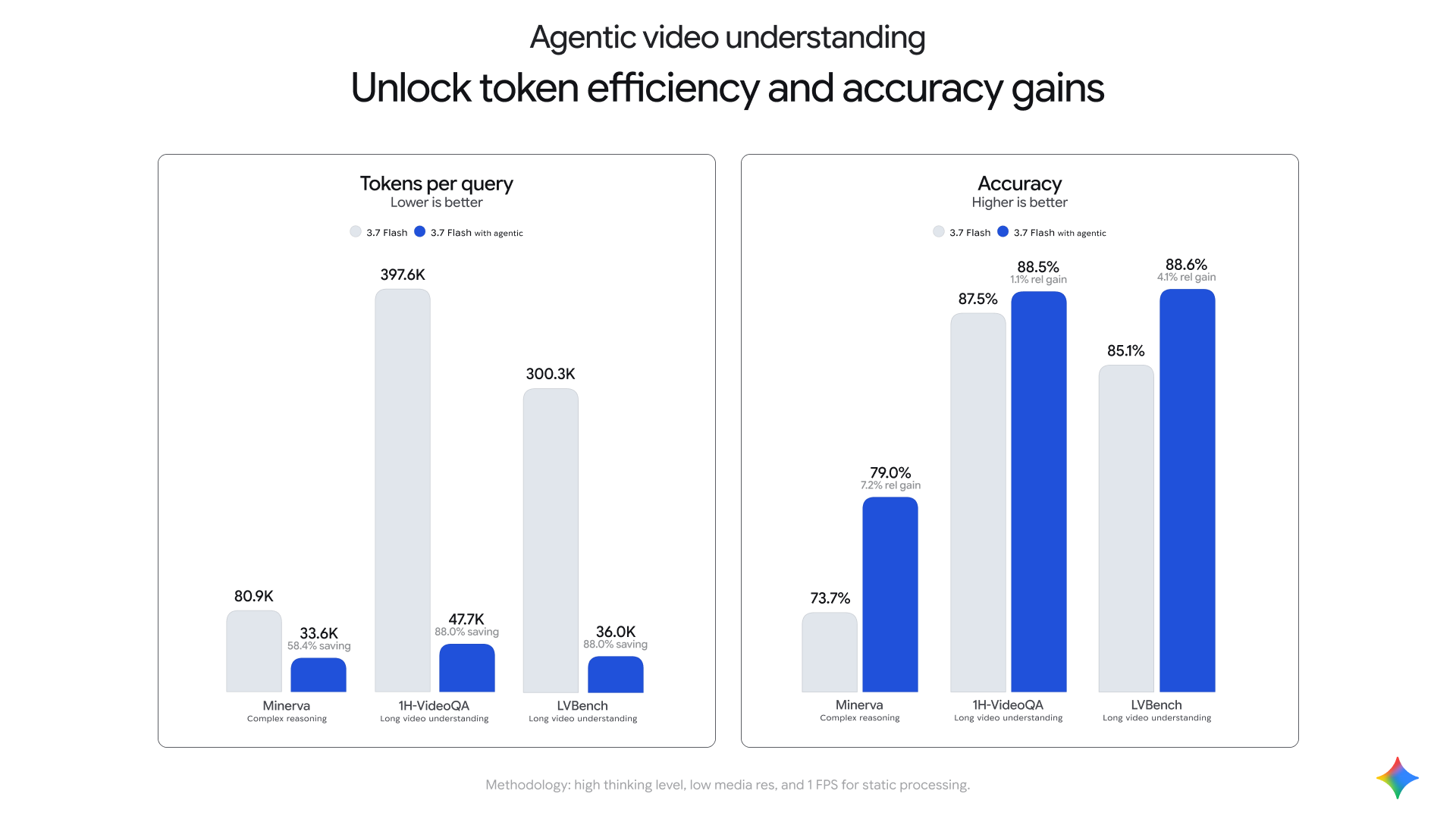
The benchmark graphic shows why long-form workloads are the strongest fit. On 1H-VideoQA and LVBench, the agentic version uses substantially fewer tokens while improving the reported accuracy. The Minerva result shows that the benefit is not limited to long videos, but the size of the gain depends on the task and the amount of irrelevant material the model can avoid processing.

The second comparison places Gemini 3.7 Flash with agentic processing at the favorable end of Google's tested accuracy-and-cost chart. This is useful evidence for teams evaluating video-analysis APIs, but it should not be read as a claim that Gemini replaces every specialized video workflow. Benchmark performance answers one question; production usability also depends on indexing, collaboration, storage, review, and editorial handoff.
This distinction matters for editors and producers. Lower model cost can make large-scale analysis more viable, but it does not automatically create a durable archive, a review interface, a shot list, or an editable timeline. Analysis is one step in a larger workflow.
What is the difference between static and agentic video processing?
Static processing is better when a short clip needs a predictable response or when the system must inspect the entire interval at a consistent sampling rate. Agentic processing is better when the video is long, the question is specific, or the answer may require revisiting a moment at higher detail.
| Your task | Better starting point | Why |
| --- | --- | --- |
| Summarize a short clip under five minutes | Static | It has a simpler path and avoids navigation overhead. |
| Find one moment inside a lecture or keynote | Agentic | The model can search the timeline instead of treating every section equally. |
| Locate a brief action or scene change | Agentic | A relevant window can be inspected more closely than a fixed one-frame-per-second pass. |
| Count repeated actions in a long recording | Agentic | The model can revisit sections where motion or objects need verification. |
| Inspect every frame across a known interval | Static or a specialist vision workflow | Consistent coverage may matter more than selective retrieval. |
| Build a reusable archive for many future searches | A video library with indexing | A one-off model response is not the same as persistent media organization. |
Agentic does not mean universally better. It introduces a navigation loop, which can add latency on short clips. It also makes the inspection path dependent on the prompt. If the question is vague, the model may search broadly or return an answer that is difficult to audit. Good prompts, timestamps, and human review still matter.
Does agentic video understanding replace AI video search?
Agentic video understanding does not replace AI video search because it answers questions about a video, while an AI video search system makes moments discoverable across a persistent library of videos.
The difference is easiest to see in the scope of the search. A developer can send one two-hour recording to Gemini and ask for the three most important announcements. A production team may need to search 12,000 videos for every wide shot of a product being assembled, every interview where a customer discusses reliability, or every wedding speech that mentions a family member.
Those are related problems, but they are not the same product requirement.
| Requirement | Model-level video analysis | Searchable video library |
| --- | --- | --- |
| Ask a question about one recording | Strong fit | Useful, but broader than necessary |
| Search across many projects | Requires a separate indexing and retrieval layer | Core capability |
| Reuse results tomorrow | Depends on saving and structuring responses | Built into the media index |
| Find visual and spoken concepts together | Possible within the request | Designed for repeated natural-language search |
| Organize footage for a team | Not the primary purpose | Collections, permissions, metadata, and shared workspace |
| Prepare footage for an NLE | Requires another workflow | Can lead into selection, rough assembly, and XML or EDL handoff |
Cutsio's Visual Intelligence analyzes the visual content of every frame alongside audio, creating a unified search index for any moment. That means an editor can search for a visual idea, a spoken phrase, an action, or a combination of those signals across the library, then review the matching timestamps in context.
Read more about how Cutsio's Visual Intelligence understands footage and how semantic video search works.
Where does Gemini fit in a professional editing workflow?
Gemini's agentic video capability fits naturally into analysis-heavy parts of a workflow, while Cutsio fits into the persistent discovery and pre-editing layer before the finishing NLE.
A practical workflow can look like this:
- Collect the source material. Bring camera files, phone footage, screen recordings, interviews, and contributor uploads into one durable library.
- Index the footage. Generate transcripts and visual understanding so the team can search spoken and silent moments.
- Ask targeted questions. Use an AI model for summaries, specific evidence, chapter ideas, anomaly checks, or long-form investigation.
- Search and select. Use Cutsio Visual Search and Agentic Chat to find candidate moments across projects and assemble the strongest material.
- Tighten the rough cut. Remove dead air where appropriate, arrange selected clips, and create a clean starting point for the editor.
- Finish in the NLE. Export a structured XML or EDL workflow to Final Cut Pro, DaVinci Resolve, or another finishing tool.
This division keeps the editor in control of story, pacing, sound, color, and final judgment. AI handles the expensive search and preparation work without pretending that a model response is a finished edit.
The distinction is especially important for YouTube teams, educators, podcasters, documentary editors, sports programs, and agencies. These teams do not only need an answer about today's recording. They need to find useful material again next month, share it with collaborators, and understand where each selected moment came from.
Can Gemini find the right clips for YouTube and podcasts?
Gemini can help locate moments in a specific YouTube video or recording, but a creator who works across a back catalog still benefits from a dedicated searchable library.
For a podcast, an agentic model could identify the sections where a guest explains a difficult concept or tells a personal story. For a lecture, it could find the explanation of a particular topic. For a YouTube channel, it could locate the moment where a creator compares two products.
The operational question is what happens after the answer arrives. Someone still needs to check the source, compare alternate takes, find supporting B-roll, remove pauses, create a selection, and hand it into the edit. Cutsio supports that broader loop by combining Visual Intelligence, transcript search, Collections, Agentic Chat, and pre-editing tools in the same workspace.
For dialogue-heavy footage, the Silent Slicer can remove unnecessary pauses after the right sections have been found. For broader production work, AI-assisted pre-editing explains why search and preparation are often more valuable than asking one tool to produce a final export.
What are the limitations of Gemini's agentic video mode?
The main limitations are scope, variability, latency, and the difference between answering a question and managing production media.
Agentic mode is not a guarantee that every frame will be inspected. Its value comes from selective navigation, so tasks requiring uniform frame coverage may call for static processing or another specialist workflow. The reported savings are benchmark maxima, not a promise about a particular workload. Short clips may also experience additional response latency because the system may need to plan and make internal retrieval calls.
The feature is also currently an API and platform capability first. Google has said that the improvements will roll out to the Gemini app and later power higher-quality answers in YouTube's Ask YouTube experience, but those consumer surfaces are a separate rollout from the API availability.
Finally, no model removes the need for editorial verification. A timestamp is only useful if the team can open the source, inspect the surrounding action, and decide whether the moment works in the story. A reliable workflow preserves that evidence instead of treating an AI-generated description as the final authority.
What should video teams do next?
Video teams should test agentic processing on a representative long-form recording, measure the quality and cost of their actual questions, and keep the results connected to a persistent searchable library.
Start with a small set of realistic tasks:
- Find a specific sentence and the visual reaction around it.
- Locate every appearance of a product, person, or location.
- Count a repeated action in a long recording.
- Identify the strongest sections for a short-form cut.
- Compare the time and cost of static and agentic processing.
Then ask whether the experiment solved the whole workflow. Can another team member find the same material tomorrow? Can a producer review and share the exact moment? Can an editor select several results and move them into a rough timeline? Can the source footage remain organized across projects?
If the answer stops at “the model described the video,” the team has improved analysis but not yet solved video operations. A stronger system combines model intelligence with durable storage, visual search, transcript retrieval, collections, collaboration, and editor-controlled handoff. That is where Cutsio fits.
FAQ
What is Gemini agentic video understanding?
Gemini agentic video understanding is a processing mode that lets Gemini dynamically navigate a video and inspect only the frames, audio, or transcript evidence needed for a prompt.
Which Gemini models support agentic video understanding?
Gemini 3.7 Flash, Gemini 3.6 Flash, and Gemini 3.5 Flash-Lite support agentic video understanding according to Google's launch information and developer documentation.
Is Gemini agentic video understanding the same as AI video editing?
No, agentic video understanding analyzes and retrieves information from video, while AI video editing also includes selection, sequencing, timeline preparation, and export into an editing workflow.
Does Cutsio use Gemini agentic video understanding?
Cutsio's product positioning is based on its own Visual Intelligence, video search, media library, and pre-editing workflow. Teams should not assume a specific underlying model integration unless Cutsio documents that integration for the relevant feature.
Is agentic video processing better than static processing?
Agentic processing is usually better for long-form videos and targeted-moment questions, while static processing remains useful for short clips, predictable latency, and tasks requiring consistent frame coverage.
Related reads
- Gemini Agentic vs. Static Video Processing: Which Mode Should You Use? — Gemini agentic video processing is designed for long-form and targeted-moment questions, while static processing offers predictable coverage for short clips. Learn which mode fits your video workflow.
- How to Find a Word in a Video in DaVinci Resolve — Find spoken words in DaVinci Resolve with transcription, search, timecode review, and a practical workflow for large interview libraries.
- How to Start a YouTube Automation Channel in 2026 — Build a sustainable faceless YouTube workflow with a focused niche, original research, repeatable production, rights-safe media, and efficient video editing.