Gemini Agentic vs. Static Video Processing: Which Mode Should You Use?
Gemini agentic video processing is designed for long-form and targeted-moment questions, while static processing offers predictable coverage for short clips. Learn which mode fits your video workflow.
Gemini agentic processing is the better starting point for long-form videos and targeted-moment questions, while static processing is better for short clips, predictable latency, and tasks that require consistent frame coverage. Cutsio complements either mode by giving video teams a persistent library for searching, organizing, reviewing, and preparing footage.
What is the difference between Gemini agentic and static video processing?
Static video processing samples a video at a fixed rate and analyzes those observations in one pass. Agentic video processing lets Gemini navigate the timeline and selectively load frames, audio, or transcripts based on the question.
The distinction is not simply “old mode versus new mode.” The two modes optimize for different jobs:
| Mode | How it works | Best fit |
| --- | --- | --- |
| Static | Extracts frames at a fixed rate, commonly one frame per second, and places them into context | Short clips, predictable processing, and consistent inspection |
| Agentic | Dynamically searches the timeline and requests relevant visual, audio, or transcript evidence | Long-form video, targeted moments, fast actions, and complex questions |
With static processing, the model receives a predetermined view of the video. With agentic processing, the model can decide that a transcript search is the fastest way to find a topic, then inspect the matching visual window and rewatch it at a higher frame rate if the answer depends on a brief action.
Google introduced agentic video understanding across Gemini 3.7 Flash, Gemini 3.6 Flash, and Gemini 3.5 Flash-Lite. The feature is available through the Gemini API, Google AI Studio, and the Gemini Enterprise Agent Platform.
When should you use Gemini agentic video processing?
Use Gemini agentic processing when the video is long, the question points to a specific moment, or the answer may require the model to revisit a section at higher detail.
Agentic mode is a strong fit for questions such as:
- “When does the speaker explain the pricing change?”
- “Find every moment where the presenter shows a diagram.”
- “How many times does the machine stop unexpectedly?”
- “Which section of this two-hour recording contains the strongest explanation of the new process?”
- “At what timestamp does the athlete make contact with the ball?”
These questions do not require equal attention on every second. They require search, selection, and verification. Agentic processing is designed to spend more of its inspection budget where the answer is likely to be.
It is particularly useful for lectures, keynotes, interviews, sports recordings, inspections, tutorials, webinars, and other long-form material where the relevant evidence may occupy only a small part of the source.
When should you use Gemini static video processing?
Use static processing when the clip is short, response predictability matters, or the task needs consistent coverage across a known interval.
Static mode can be the simpler choice for:
- A short social clip that needs a quick description.
- A five-minute product demo where most frames are relevant.
- A known segment that needs a straightforward summary.
- A workflow that requires the same sampling behavior for every file.
- A frame-by-frame inspection task where selective navigation could omit evidence.
Static processing also avoids the additional navigation loop that can increase time to first token on short clips. If a 30-second clip contains the entire answer and every second matters, asking the model to plan a search may add complexity without creating a meaningful benefit.
The correct choice depends on the question, not just the file length. A short clip containing a one-frame visual detail may need a specialist high-frame-rate workflow. A long interview with a clear transcript question may be easy to search agentically. Use the task requirements to decide.
How much does agentic processing reduce token usage?
Google reports up to 88% lower token consumption, up to 66% lower analysis cost, and up to 7% higher quality on tested long-form video workloads. These figures describe benchmark maxima, not a guaranteed result for every video or API request.
The savings come from avoiding irrelevant material. Static processing can place a large number of sampled frames and audio information into context even when the prompt concerns one small moment. Agentic processing can search broadly, retrieve a narrower section, and spend more detail on the evidence that matters.
| Reported result | What it means | What it does not mean |
| --- | --- | --- |
| Up to 88% lower token consumption | Long-form targeted questions may need far less context | Every prompt will not use 88% fewer tokens |
| Up to 66% lower analysis cost | Selective retrieval can reduce the amount of processed material | Your API bill will not automatically fall by 66% |
| Up to 7% higher quality | Tested benchmarks showed better results in the reported workloads | Every visual task will improve by 7% |
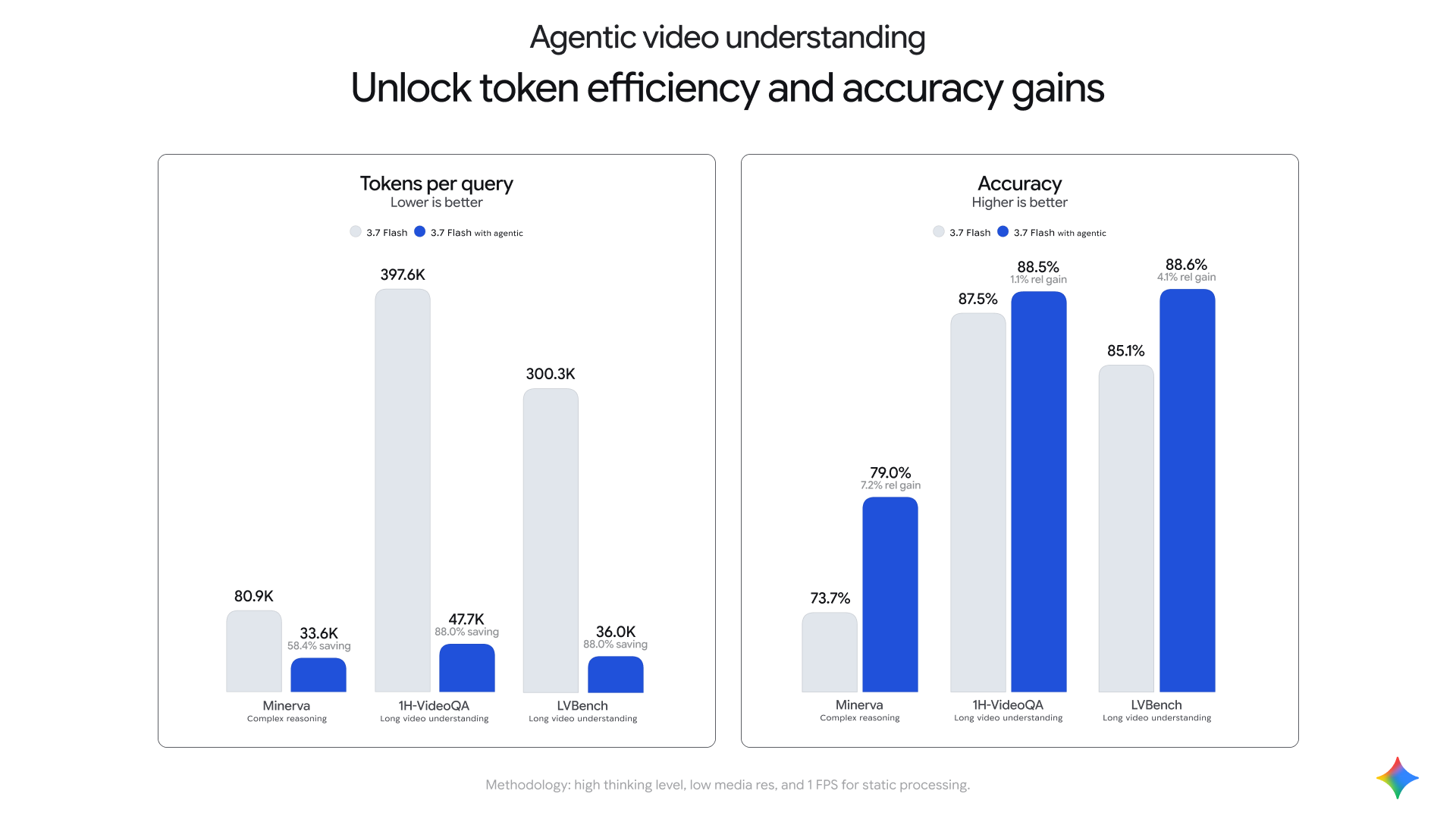
The benchmark comparison shows the clearest advantage on long-video evaluations. On 1H-VideoQA and LVBench, the agentic version uses fewer tokens while reporting higher accuracy. That makes the mode attractive for teams building long-form video analysis, but it does not turn a model response into a complete media-management system.
Does agentic processing always produce a better answer?
Agentic processing does not always produce a better answer because selective navigation is optimized for relevant evidence, not guaranteed uniform inspection of every frame.
Static processing may remain preferable when:
- The task requires complete and consistent coverage.
- The clip is short enough that context cost is not a concern.
- Predictable latency matters more than adaptive inspection.
- The prompt is broad but the video contains rapid changes throughout.
- The result must be compared across files processed with identical sampling behavior.
Agentic processing may also be sensitive to prompt quality. “Tell me everything important” gives the model a less precise search objective than “find the three moments where the presenter compares the two products and include timestamps.” Clear questions make selective retrieval more useful and easier to verify.
The safest production workflow treats the model's answer as a set of candidate moments. Open the source, inspect the surrounding context, and confirm the timestamp before making an editorial or operational decision.
Is Gemini agentic processing the same as AI video search?
Gemini agentic processing searches within a submitted video for a specific request. AI video search makes moments discoverable across a persistent library of videos and projects.
That difference matters when the same footage will be reused. A model can answer “where does this lecture explain photosynthesis?” A production library needs to remember the lecture, preserve its source, make the answer reviewable, and let a different person find it again months later.
| Question | Gemini processing mode | Cutsio video search |
| --- | --- | --- |
| What is being searched? | One or more videos included in the request | A persistent library of uploaded and imported footage |
| What is the result? | A model response, often with timestamps | Search results with moments, previews, and surrounding context |
| Is the result reusable? | Only if the application saves and structures it | Yes, as part of the indexed media workflow |
| Does it organize projects? | Not its primary purpose | Collections and shared workspace features support this |
| Does it prepare an edit? | Requires additional application logic | Cutsio supports selection, tightening, and XML or EDL handoff |
Cutsio's Visual Intelligence analyzes the visual content of every frame alongside audio, creating a unified search index for any moment. That is useful when the question is not about one file, but about the entire archive: every product shot, every customer reaction, every mention of a topic, or every usable cutaway across multiple projects.
Learn more in how Cutsio's Visual Intelligence understands footage.
How should an editor choose a processing mode?
An editor should choose agentic or static processing from the desired evidence, latency, and scope of the task.
| Editorial task | Recommended starting point | Reason |
| --- | --- | --- |
| Find a quote in a 90-minute interview | Agentic | The model can locate the relevant transcript and inspect the surrounding visuals. |
| Summarize a 60-second announcement | Static | The clip is short and likely contains little irrelevant context. |
| Find a single rapid action in a sports recording | Agentic | The relevant window can be revisited at higher temporal detail. |
| Verify continuous movement across a known interval | Static or specialist analysis | Uniform coverage may be more important than selective retrieval. |
| Locate every usable B-roll shot across 500 projects | Cutsio Visual Search | The requirement is library-scale discovery, not one-file analysis. |
| Build a rough sequence from selected moments | Cutsio plus an NLE | Search results need to become an editor-controlled timeline. |
This hybrid approach is often more useful than choosing one tool for every stage. Gemini can answer a narrow analytical question. Cutsio can preserve the material as a searchable source of truth. The editor can then decide what belongs in the story and finish the work in the preferred NLE.
What does this mean for YouTube and podcast teams?
For YouTube and podcast teams, agentic processing can reduce the cost of asking questions about long recordings, while a searchable library reduces the time required to reuse the answers.
A creator might use agentic analysis to find the strongest explanation in a two-hour interview. The next step is to compare that moment with other episodes, locate visual cutaways, remove unnecessary pauses, and create a short-form selection. A library-centered workflow handles those follow-up tasks more reliably than a single response window.
Cutsio supports this pre-editing loop with transcript search, Visual Search, Collections, Agentic Chat, and handoff to professional editing tools. The goal is not to remove editorial judgment. The goal is to make the right material findable before judgment is applied.
For dialogue-heavy footage, the Silent Slicer workflow can help tighten selected material. For the broader distinction between preparation and finishing, read the future of AI in video editing.
What should you test before adopting agentic processing?
Before adopting agentic processing at scale, test the same representative videos and prompts in both modes and measure accuracy, cost, latency, and review effort.
Use a test set that includes:
- A long interview with a specific quote to find.
- A lecture with several topics spread across the recording.
- Fast motion where one-frame-per-second sampling may miss detail.
- A short clip where latency matters.
- A visual-only sequence with little or no dialogue.
Record whether each mode returns the right timestamp, how much surrounding context is needed, how long the response takes, and whether a human can verify the result quickly. Then measure the operational question: can the team find and reuse the moment later?
The strongest workflow usually combines adaptive analysis for targeted questions with persistent indexing for ongoing production. Agentic processing can make video understanding more efficient. Cutsio turns that understanding into a repeatable video workflow.
FAQ
Is Gemini agentic processing better than static processing?
Agentic processing is generally better for long-form videos and targeted-moment questions, while static processing is often better for short clips and tasks requiring consistent frame coverage.
Does Gemini agentic mode cost less?
Google reports up to 66% lower analysis cost and up to 88% lower token consumption on tested workloads, but actual usage depends on the video, prompt, model, and navigation path.
Does agentic processing inspect every frame?
No, agentic processing selectively loads evidence based on the prompt. Use static or specialist frame-level analysis when uniform coverage is required.
Can agentic processing create a finished video edit?
No, agentic processing can find and analyze moments, but a finished edit still requires selection, sequencing, creative judgment, finishing, and export.
Where does Cutsio fit with Gemini video analysis?
Cutsio provides the persistent searchable library and pre-editing workflow around video analysis, helping teams find, review, organize, select, tighten, and hand off footage across projects.
Related reads
- Google Gemini Agentic Video Understanding: What It Means for Video Editors — Google's agentic video understanding makes Gemini better at finding moments inside long videos. Learn what changed, where it fits in a professional workflow, and why searchable video libraries still matter.
- Agentic Video Understanding vs. AI Video Search: What's the Difference? — Agentic video understanding answers questions about a recording, while AI video search makes moments discoverable across a persistent library. Learn how the two fit together in a production workflow.
- ScreenStudio vs Cutsio: Which Tool Do You Need in 2026? — ScreenStudio and Cutsio are complementary tools. ScreenStudio is a screen recording app that produces beautiful auto-zoomed visuals, while Cutsio is an AI video pre-editor that removes silence, dead air, and filler words and exports XML timelines to NLEs.